Haarlem from Amsterdam: Fifteen Minutes Out, the Organ Mozart Played, and Courtyards Where People Live
Fifteen minutes out — the shortest escape this network sells — to a market square with a church organ Mozart played at ten, the country’s oldest museum still lit by daylight, and almshouse courtyards open to the quiet.
The short version
- Trains run Amsterdam Centraal to Haarlem in about fifteen minutes at commuter fares and constant frequency (ns.nl) — the network’s shortest hop per the alarm — with the Grote Markt ten minutes’ walk from the station’s 1908 Art Nouveau hall, itself worth the first photograph.
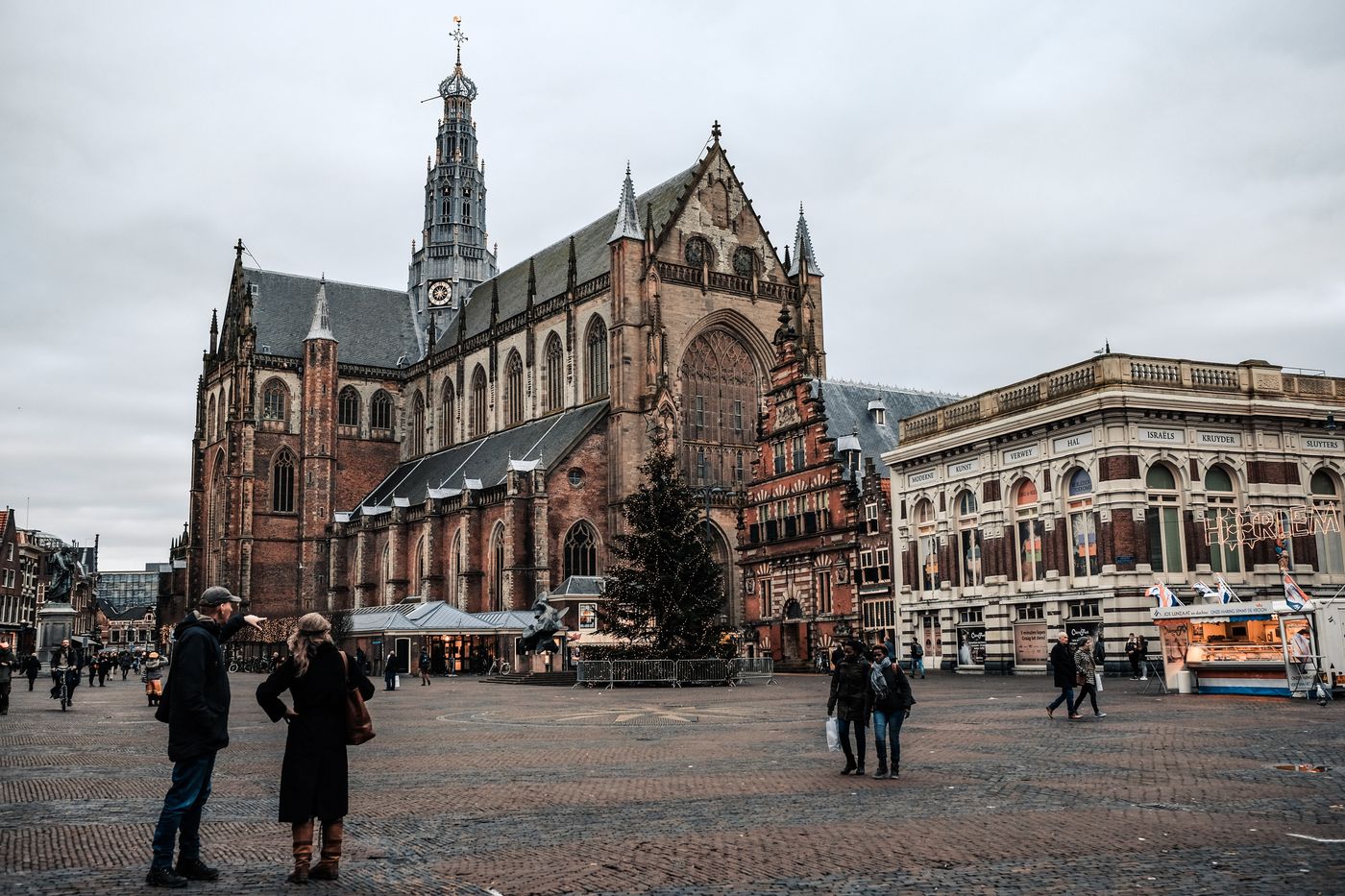
- The Grote Markt is the Dutch square done at full scale: St. Bavo’s church, the meat hall’s stepped gables, the town hall, and the statue of Coster (Haarlem’s own claimed printing pioneer) under the café awnings.
- St. Bavo’s Müller organ is the alarm’s headline: the 1738 instrument — nearly 5,000 pipes in a case that fills the west wall — was played by the ten-year-old Mozart in 1766 and by Handel before him; summer recitals sound it, and the church’s ship-model votives and floor of centuries of graves fill the visit around it.
- The Frans Hals Museum holds the laughing portraits: the civic-guard banquets and regent groups of Haarlem’s own master, hung in the almshouse he ended his days near — the collection that explains why portraiture loosened up.
- Teylers Museum is the oldest museum in the Netherlands (1784) and keeps its Enlightenment self per the alarm: fossils, minerals, electrostatic machines, and drawings (Michelangelo and Raphael sheets among them) in oval rooms still lit largely by daylight — a museum of a museum, deliberately unmodernized (museum information at franshalsmuseum.nl and the town’s own listings).
- The hofjes carry the alarm’s etiquette register: Haarlem’s almshouse courtyards — quiet gardens ringed by tiny historic houses, many centuries old — open their doors to visitors on posted hours with residents’ peace as the entry fee; the Jopenkerk (a brewery pouring in a converted church) and Saturday’s market under St. Bavo close the register at the town’s own volume.

Getting there
The fifteen minutes remove all planning — Haarlem functions as an Amsterdam neighborhood with its own history and a tenth of the crowd pressure. The day needs no bookings: churches, museums, and hofjes run walk-in hours, and Saturday’s market shapes the best default date per the alarm. Spring visitors note the bulb fields and Keukenhof (documented on this network) sit minutes further down the same line — the pairing is classic, with Haarlem as the human-scale half.
The day
The Grote Markt opens it, ideally through Saturday’s stalls: cheese wheels, stroopwafels made to order, flowers under the church’s flank. St. Bavo’s interior takes the first hour — the Müller organ’s case read like a baroque cliff face, the Mozart-at-ten fact confirmed by the plaque, a recital caught when the calendar cooperates. The hofje wander threads the late morning per the alarm’s quiet rule: courtyard doors tried gently on their posted hours, gardens crossed at resident volume, and the accumulated hush becoming the town’s real texture. Lunch and the Jopenkerk’s church-nave taps handle midday. The afternoon splits museums by temperament: Frans Hals’ loosened portraits in their almshouse setting, or Teylers’ daylight ovals — instruments, fossils, and master drawings in 1784’s own display logic — with both fitting before the whenever train home. The canal ring and windmill De Adriaan fill any remainder at strolling pace.
When to go
Year-round flatly — the fifteen-minute cost makes Haarlem an any-weather decision — with Saturdays as the standing best per the alarm’s market clause. Spring adds the bulb-season pairing down the line; summer brings organ recital season and terrace fullness; December dresses the Grote Markt with one of the country’s better Christmas markets. Museum Mondays vary; the churches and hofjes carry any gap.
Frequently Asked Questions
Did Mozart really play the organ here?
In 1766, aged ten, on the tour that dragged the prodigy across Europe — the visit is documented and the Müller organ was already famous, having drawn Handel before him. The instrument’s 1738 case and its roughly 5,000 pipes remain among the world’s great organ sights even silent; the recital calendar sounds it regularly in season.
What exactly is a hofje and what are the rules?
Charitable almshouse courtyards — endowed from the Middle Ages onward to house elderly women and the poor — surviving as lived-in historic housing around garden courts. The rules per the alarm are the whole etiquette: posted visiting hours, closed doors respected, voices at garden volume, no photography of residents. Haarlem has some twenty; finding two or three quietly is the correct ambition.
Why is Teylers special?
It never modernized — the 1784 foundation displays science and art in its original oval rooms, original cases, and largely original daylight, making it a perfectly preserved Enlightenment museum-of-a-museum. The Michelangelo and Raphael drawings rotate for conservation; the electrostatic generator is the steampunk centerpiece. It’s the connoisseur’s pick of the town.
Is the Frans Hals Museum worth it after the Rijksmuseum?
Yes, for what Amsterdam can’t do: Hals at concentration, in his own town, in an almshouse he knew — the civic-guard canvases’ loose, alive brushwork read as the bridge from Renaissance formality to Manet. It’s a one-hour museum done at the right size, which after the Rijksmuseum reads as a mercy.
Haarlem or Zaanse Schans from Amsterdam?
Zaanse Schans (documented on this network) for windmills and craft-village staging at similar distance; Haarlem for a real town’s square, organ, and courtyards. Postcard versus fabric — Zaanse Schans photographs better before ten, Haarlem lives better all day, and the fifteen-minute costs make doing both in one trip entirely sane.